
Whatever the weather this day, consider it spring! The time has come to search for hints and outright signs of early growth, indicating good things ahead. We can encourage plants to flourish, but it’s best to recognize when they’re ready to grow. Meanwhile, there are unexpected spring jewels ready to dazzle us.
Appreciate the joys of early spring, but be patient for the bursting buds and blossoms.
Early spring arrivals might surprise you.
It doesn’t take many days of strong spring sunlight to awaken some beautiful plants and creatures. Among the earliest to show themselves are the sweet Canada violets growing in odd corners, around tree trunks and spreading into lawns. These beautiful violets have a candy scent if you can get down close enough for a sniff, and their rich purple colour is vivid in early sunlight.
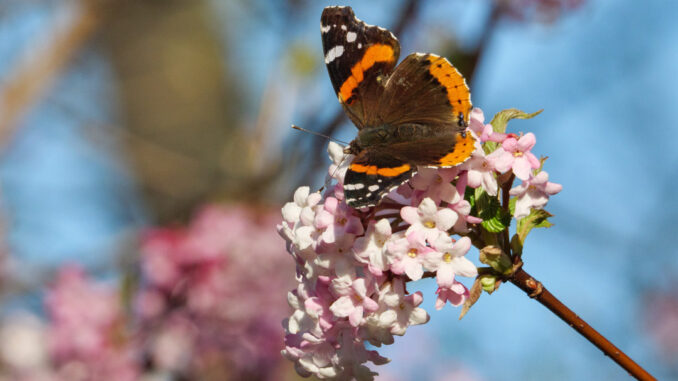
Hidden along bare tree branches and under leaf debris, there’s a beautiful rustling taking place as the earliest seasonal butterflies are waking. These over-wintering butterflies take to the air when scented spring flowers emerge, before foliage on the bare wood of shrubs and trees. The dramatic Mourning Cloak butterfly will sometimes fly even while snow drifts are still melting, and often spreads its cream-bordered black wings on a heat-absorbing stone. Mourning Cloaks will also join with Red Admiral butterflies drawn to emerging pink flowers on the bare wood of early blooming viburnum. They both relish the bright yellow flowers of Cornelian-cherry Dogwood (Cornus mas ‘Golden Glory’), a large shrub that also produces a bonus of edible red berries in early summer. Blooming at the same time are the tissue-thin, pale pink flowers of semi-dwarf apricot trees growing 10 to 12 feet in height. Hardy apricot trees such as ‘Harglow’, ‘Veecot’ and ‘Moorpark’ have been bred for cold climates, are suitable for small gardens and always welcome the attention of earliest butterflies.
It’s all about the timing
After a long northern winter, every gardener wants to greet the spring growing season with a rapid demonstration of vigorous plant growth. There is great temptation to purchase fertilizer products and distribute them to lawns and plants as early as possible. Depending upon timing, this can produce two results – either a display of vigorous green blades, stems and buds, or withered roots and twigs that may require several weeks to recover. What went wrong? Knowing more about how plants grow helps put fertilizer use into perspective.
When planting summer annuals or newly purchased perennial and woody plants, the best method of supplying fertilizer is to use a commercial transplanting solution. Liquid concentrate transplanting solutions are formulated with the appropriate amount of minerals to encourage early growth without burning roots of new plants going into containers or garden soil.
Garden plants have inherited genetic information about how and when to grow. Healthy plants (both woody shrubs and trees and herbaceous perennials) sense spring changes in light, moisture and soil temperature and react by producing growth hormones at appropriate times. The most vigorous production of plant growth hormones is in spring, followed by occasional growth spurts during the summer season. As soil temperature and light diminish in late summer, plants will stop their growth cycles and begin to harden cell walls in advance of freezing temperatures.
In other words, garden plants can get along fine without the support of fertilizers. They may not produce enough blooms to suit us, but they will thrive as long as appropriate light and moisture are available. But still, there is the lure of stimulating thicker green turf grass and more rose blossoms with fertilizer applications. This can be safely done by understanding when to apply supplemental nutrients and in what concentration.
The best timing for fertilizer application is different for various categories of garden plants. They’re not all on the same growth schedule and you may notice that some woody plants – such as honeysuckle and forsythia, and hardy perennials – such as daylilies and foxgloves will show green shoots in early spring when nights are still slightly below 0 degrees Celsius (32 degrees Fahrenheit). Turfgrass lawns wait for above-freezing nights and daytime temperatures above 10 degrees Celsius (50 degrees Fahrenheit) before extending blade growth.
Applying fertilizer before they’re ready to grow creates a problem for plants. They aren’t yet prepared to use nutrients before the seasonal cues indicate safe and appropriate conditions for growth. Roots may be burned and growth can be stunted. A stunted plant is in a period of shock, when its normal biological process has been interrupted and growth is retarded. This can be easily avoided by putting aside the calendar and letting the plant demonstrate when it’s ready for growth. Let swelling buds on woody trees and shrubs eventually crack open, extending new twigs and the first two sets of leaves before offering fertilizer feeding. Those new leaves are the factories that use fertilizer to produce nourishing food for all of their seasonal needs. Also, with roses and herbaceous perennials, allow the first two sets of green leaves to be extended before applying supplemental feeding.
Commercial fertilizer products have directions on their packaging regarding how much to apply, and it’s important to not exceed that amount. The three main plant foods – nitrogen, phosphorus and potassium – correspond to the three numbers on the front of every plant food product. These foods influence strong green growth (nitrogen), formation of buds and roots (phosphorus) and strong cellar walls (potassium). They work best when used together, although not necessarily in equal amounts. Fertilizers can be ‘balanced’, meaning equal amounts of each element (such as 10-10-10); or they can be staggered to emphasize one category over the other two (such as 5-15-5). Most effective is when at least a small amount of each fertilizer element is included to get the best growth result.
By Judith Adam