
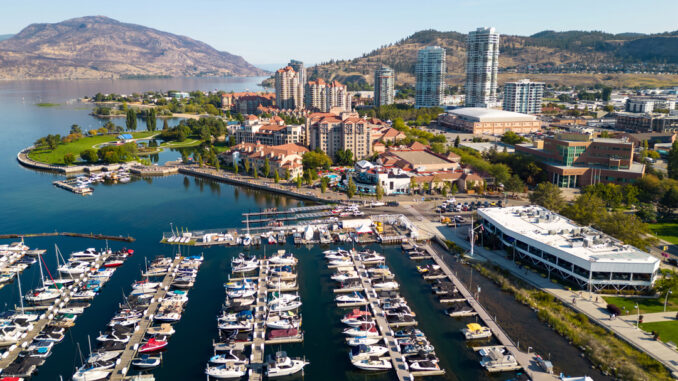
One of British Columbia’s most popular playgrounds.
Becoming captivated by the Okanagan Valley’s repertoire of attractions is both easy and irresistible. On my first trip there, I was immediately seduced by the region’s natural charm and, as the excursion unfolded, every day produced a new reason to love the place. With sun-drenched hills and mountains, together with a mild Mediterranean-like climate, this stunning valley in the province’s south-central interior is sometimes referred to as the “Tuscany of Canada.” Its assets, however, are greatly expanded beyond its pleasant continental temperatures. The region’s enviable reputation has been largely built on its rare blend of world-class wineries, top-notch golf courses, year-round outdoor recreation, charming towns and a plethora of lakeside beaches. The showstopper – and arguably the area’s main attraction – is the 84-mile-long Lake Okanagan. In fact, the valley’s geography is primarily shaped by this scenic lake that divides the valley from north to south. Consequently, it serves as the central spine of the region in addition to providing a wealth of sandy beaches and water sports opportunities. Overall, it’s impossible to be unimpressed by the valley’s vast trove of attractions, both natural and man-made – a claim easily supported by the sheer abundance of what the area has to offer. Missionaries who built the valley’s first settlement in the mid-1800s – together with the indigenous people who were already there – could never have envisioned the Okanagan Valley of the future. Today’s bonanza of things to see and do would have been merely the stuff of wild dreams. Over time, and by every measure, the wild dreams became real. What follows are some of the features which make this remarkable region one of the country’s prime travel destinations – one which causes me to berate myself for not having visited sooner.
A Wine Lovers’ Utopia
It is not from a sudden rise to distinction that the valley’s wine industry presently ranks as one of the Okanagan’s top attractions. The first grapevines were planted in 1859 by a French Catholic priest, thereby marking the beginning of the region’s entry into the world of winemaking. Today, with as many as 200 wineries, the Okanagan Valley is among the largest grape-growing areas in Canada, with only Ontario’s Niagara Region quantitatively bigger. At present, the region’s extensive wine-producing operations range from iconic estate wineries to small boutique enterprises and hidden gems. While it took decades for the industry to achieve its present state and its reputation as the “Napa Valley of the North,” today’s Okanagan wines enjoy an enduring reputation and international recognition. Large-scale establishments such as the Mission Hill Family Estate Winery and Quails’ Gate share the region’s vast viticulture space with an outstanding variety of others, including Nk’Mip Cellars – the first indigenous-owned winery in North America.
For visitors, group tasting tours are an ideal way to get introduced to the Okanagan’s rich and varied wine tableau. These are typically led by expert guides who know both their wines and the valley’s history of grape growing and winemaking. There are sip-and-savour tours of various lengths, with many offering dining options ranging from casual patio fare to fine dining. A natural bonus to any of the area’s wine tours is the valley’s breathtaking scenery – stunning views of rolling hills, forested slopes, glacial-sculpted mountains, blossoming fruit orchards and vistas of Lake Okanagan, together with unique desert stretches in the valley’s lower south. While there is no bad time to visit this special region in which wine tours are offered year-round, spring and fall provide optimum weather conditions. My own trip was a summer excursion in hot, dry, sunny weather, often considered some of the best in Canada.
Tee Up for Golf
When it came to golf, the Okanagan Valley hit my sweet spot as a player and lover of the game. Back when the region was defined by little other than orchards, vineyards and ranch land, it couldn’t have taken much imagination to picture the area becoming one of Canada’s premier golf destinations. Blessed with the sunniest and driest climate in the country, together with a diverse topography of mountains, rolling hills and lakes, golf course development was inevitable. A couple of decades ago, clubs began popping up like dandelions in spring. Today, this balmy region boasts well over 30 courses ranging from low-lying valley layouts to mountain and hillside tracks spread over a natural canvas of jaw-dropping scenery. Along with the wine industry, golf now ranks as one of the region’s main attractions.
With many of the courses designed by some of the world’s top golf architects, the Okanagan has become a premium place to hit the links. Legendary designers such as Jack Nicklaus, Thomas McBroom, Doug Carrick and Fred Couples have turned stretches of the region’s remarkable landscape into some of the finest courses anywhere on the planet. Names such as Predator Ridge, Quail and Bear, Black Mountain and Tower Ranch are names in the golf world capable of getting a player’s heart pumping. In addition to the big-name courses, the valley offers numerous affordable options beyond the high-end tracks. There are plenty of excellent, value-focused courses, as well as golf packages for bundled savings. Once golf became part of my Okanagan journey, I knew that my first trip there would not be my last.
Urban Hubs
Among its wealth of engaging towns and villages, the Okanagan Valley’s largest cosmopolitan centers are Vernon in the north, Kelowna in the centre and Penticton in the south. With all three surrounded by the region’s four-seasons playground, the defining feature among them is their immediate and easy access to wineries, vineyards, golf, hiking, biking, water sports and more. Beginning with the largest of the three, Kelowna takes full advantage of its Lake Okanagan waterfront. The beaches and offshore waters provide everything from guided lake tours to parasailing, kayaking, jet skiing and wakeboarding. The city proper features art galleries, a sculpture garden, the Okanagan Heritage Museum, farmers’ market and a state-of-the-art aerospace museum. The picturesque city of Penticton lies between Lake Okanagan and Lake Skaha. Among its extensive inventory of attractions is a booming craft beer industry, earning it the title of “Craft Beer Capital of Canada.” It also boasts a vibrant culinary scene, garden market, marine museum and a family-friendly fun-packed adventure park. Vernon, third member of the big three, is surrounded by three lakes (Okanagan, Kalamalka and Swan) offering extensive water sports, fishing and beach activities together with miles of hiking trails. It’s home to the Okanagan Science Centre, art galleries and museums. The city is also a starting point for a wine tour named the Scenic Sip Trail which runs from Vernon to Kelowna, with tasting stops at various area wineries such as Ancient Hills and Gray Monk. While each of the region’s three biggest cities benefits from the valley’s hospitable climate and natural surroundings, they are individually defined through separately developed personalities.
Desert Sun and Sand
The Okanagan’s southernmost town of Osoyoos is widely known as the home of Canada’s only desert. While ecologists refer to it as a semi-arid environment rather than a true desert such as the Sahara, it is the hottest, driest spot in the country. Its natural flora includes sagebrush and cactus and its creepy crawlies can be scorpions, salamanders and rattlesnakes. I spent two days in the charming community of Osoyoos, a place that lives up to its reputation as Canada’s only desert – semi or not. For the record, during my stay there I never saw a rattlesnake or any of the desert’s creepy crawlies. Lying just two miles north of the Canada/U.S. border, the town and surrounding area enjoy a hot, dry climate, plenty of sunshine and low rainfall. It’s these special climate conditions that helped shape the Osoyoos region’s booming wine industry, vast fruit orchards and endless outdoor activities. Together, the town and surrounding area boast four quality golf courses including the indigenous-owned Nk’Mip Canyon links owned and operated by the Osoyoos Indian Band. In addition to golf, the area has at least 40 wineries plus dozens of wine tours and festivals with such catchy names as Corks & Cactus, Sip Happens, Half Corked Marathon and Festival of the Grape. Wine and dining, of course, are not strangers; consequently, there are oodles of restaurants large and small. From fine dining to simple fare, Osoyoos eateries generally practise a farm-to-table culinary culture in which everything is local, farm-grown and on the table – often on the same day as when it was harvested. Beyond wine, dining, golf and a host of outdoor activities, the town boasts various cultural attractions. Among them is the Nk’Mip Desert Cultural Centre, a large facility that celebrates thousands of years of Okanagan First Nations life on the surrounding desert lands. With the town and area’s bounty of attractions, as well as its mild winter climate, it’s hardly surprising that the place eventually caught the attention of Canadian snowbirds. Hundreds of them return there every year – October through April – with the numbers lately increasing. Osoyoos’ accommodations include vacation properties, resorts, hotels and RV parks.
Spa Scene
Responding to the public passion for spa indulgence and wellness, the valley offers dozens of such establishments; many of them are incorporated within the region’s inventory of hotels and resorts. Among them is the outstanding Sparkling Hill Resort at Vernon, where the décor of the place is beyond stunning. More than 3.5 million Swarovski crystals are featured throughout the building from its famous KurSpa to guests’ rooms, dining space and public areas. Opened in 2010 and founded by Langes-Swarovski of the Swarovski crystal family, the resort’s design was intended to blend European-style spa culture with the Okanagan’s beautiful landscape. I had the immense luxury of staying for a couple of days at Sparkling Hill which, as it pleasantly turned out, was right next door to the Predator Ridge Golf Course –ranked as one of the valley’s top tracks.
While Sparkling Hill is among the region’s premier spa resorts, there are dozens of other options ranging from independent day spas to small boutique operations. Throughout the valley, spa and wellness menus are extensive, with treatments ranging from standard massage to thermal water therapies, laser rejuvenation, body wraps, stone reflexology and everything in between. Among the many which fall within the category of “in between” is the Beyond Rapture Spa at Kelowna, where treatments represent a nod to the Okanagan wine industry. Called vinotherapy, grape-derived treatments include a grape-pip scrub, honey-wine body wrap and grape-seed oil massage.
Valley Folklore Monster
Nobody visits the Okanagan region without hearing about the famous Ogopogo, the legendary lake monster said to inhabit the depths of Lake Okanagan. Described as a large, serpentine creature with a horse-like head, sightings of it have been reported for centuries, although there is no conclusive evidence that it ever actually existed. Nevertheless, those claiming to have seen it describe a long, dark, undulating body which creates a significant wake. Over the years, there have been many eye witness accounts together with blurry photos and videos, yet none have been deemed as definitive. The region’s indigenous people and other locals believe that the beast’s lair is a hidden cave under the lake’s Rattlesnake Island. At least two professional researchers probed the island’s waters, but came away with no proof of Ogopogo’s existence. Sightings continue to this day, with about six reported yearly. Unproven theories have suggested that the beast is a yet-unknown aquatic species or a surviving prehistoric animal. Whatever the case, Ogopogo is the popular mascot and cultural symbol of the Okanagan Valley, as well as being an important pillar of the region’s tourism platform. Oggy (the common pet name for the creature) is a folklore icon similar to Scotland’s Loch Ness Monster. nicknamed Nessie. Both are drivers of tourism without ever having been proven to exist. There are Oggy souvenir items throughout the valley from key chains to refrigerator magnets, T-shirts and stuffed animals.
By Donna Carter
Travel Planner
Getting there: Kelowna International Airport receives numerous non-stop flights from major Canadian cities including Vancouver, Calgary, Edmonton, Toronto and Victoria.
Penticton Airport receives direct non-stop flights primarily from Vancouver, Calgary and Edmonton.