
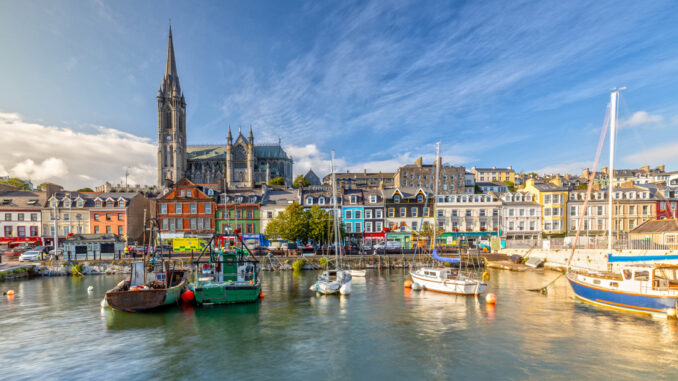
The Emerald Isle’s famous west coast drive delivers all that’s uniquely special about the land of green.
Endless attractions and ancient customs deeply woven into the fabric of Ireland are what make this awesome motor route among the finest in the world. Included in its multitude of profoundly rooted traditions is the ceremonial kissing of the country’s famous Blarney Stone. The legendary stone is built into the highest battlements of ancient Blarney Castle in County Cork, the southern anchor of the 1,600-mile-long Wild Atlantic Way trail. Like millions of others annually drawn to this distinctively magical island and its stunning west coast drive, my bucket list there included participating in the age-old Irish custom of kissing its famous stone. At Blarney Castle, I did what legions of others before me had done. I planted a kiss on the legendary rock, a ritual said to bestow a special “gift of the gab” on those who participate. I should point out that kissing the stone fixed atop one of the castle’s walls is not as simple as one might think. It requires lying on your back on a steep rock ledge situated over an open drop – 90 feet to the ground. For safety, there are iron handrails for gripping and attendants are on hand to assist. While the stone’s origins are unclear, it was added to the castle’s battlements in 1446 ‒ yet the tradition of kissing it did not begin until the late 1700s. Since then, there have been millions like me who have kissed the ancient piece of Carboniferous limestone proving that something as simple as a block of rock can become a popular tourist attraction. The Blarney Stone, however, is a mere part of what Ireland and its Wild Atlantic Way have to offer.
The route’s ribbon of landscape and rugged Atlantic coastline between the southern county of Cork and the northern county of Donegal is one of the most dramatic, stunningly beautiful and simply spectacular stretches of land and seacoast on the planet. The route overall embodies the wonders of nature and more: towering cliffs, spellbinding bays and beaches, enchanting villages, charming towns, ancient monuments and some of the richest archeological sites in Europe. Then, too, there is the ever-present Irish hospitality. The entire route can feasibly be driven in less than five hours, but so much of what it has to offer would be sorely missed. The typical visitor drives the route in stages, while others focus primarily on a particular section. No matter how the Wild Atlantic Way is explored, it is regularly regaled as the trip of a lifetime. The following is a small selection of the route’s bountiful highlights.
The Dingle Peninsula
Situated on the southwest coast of County Kerry, this finger of a land stretches 30 miles into the Atlantic Ocean. Dominated by a spine of mountains, it is known for its rugged scenery, dramatic sea cliffs and sandy beaches. There are at least three things largely guaranteed along the Wild Atlantic Way: castles, castle ruins and Irish pubs. On the Dingle, there are three main surviving castles (Minard, Gallarus and Rahinnane), with all three being 15th– and 16th-century tower houses. Regarding the pub situation: there are plenty, with more than 50 in the town of Dingle alone. Many of them are what is known in Ireland as trade-shop pubs in which dual businesses are conducted; the pouring of Guinness is on one side of the pub, and the selling of various goods ranging from groceries to hardware, linens, souvenirs, clothing, gifts and more is on the other side.
Bunratty Castle
Situated in the southwest coastal region of County Clare, this is the most complete and authentic castle in Ireland. Dating back to the 15th century, this historic icon stands on land that was once a Viking trading camp. Regular tours and medieval banquets held in this imposing edifice are designed to reveal the castle’s restored magnificence, period furnishings, tapestries and works of art. Medieval dinners are held in the castle’s Great Hall where lords, ladies and royals once lived and dined. The banquets regularly feature a period-clad group of castle singers, dancers and music. Today, Bunratty sits on 26 acres of rolling countryside amid walled gardens, a popular folk park and a “living” village heritage site.
Cliffs of Moher
In a country with no shortage of beauty and a wellspring of awesome sites, the Cliffs of Moher stand out as Ireland’s best natural attraction. In fact, it’s generally accepted that their overwhelming majesty alone makes them the crown jewel of the Wild Atlantic Way and one of the world’s natural wonders. Stretching for nearly eight miles along the rugged, southwest coastline of County Clare, the mammoth cliffs that were shaped more than 320 years ago rise 700 feet above the Atlantic. Viewing them is both awe-inspiring and humbling. Regular tours are offered by experienced guides who share the mysteries and tales associated with this rare stretch of stunning cliffs, including their distinction as one of the best places in Ireland for birdwatching. The colossal Cliffs of Moher host more than 20 distinct seabird species including Atlantic puffins, Peregrine falcons, Razorbills, Guillemot and more.
Skellig Islands
Lying off the southwest coast of County Kerry, the Skelligs are two uninhabited rocky islets famous for their breathtaking beauty, ancient monastic ruins and massive colonies of puffins, gannets and other bird life, while their offshore waters are a regular haven for seals, dolphins and whales. While Little Skellig is closed to the public, Skellig Michael (the larger of the two) is a UNESCO World Heritage Site featuring a remarkably preserved 6th-century Christian monastery perched high above the Atlantic. Visitors can climb the steep, rugged steps to view the ancient site and its “beehive” stone huts that once housed the monastery’s residents. Together, the islets are perhaps best known as remote, otherworldly sites with Skellig Michael having been used as a location for the filming of segments for two Star Wars movies ‒ The Last Jedi and The Force Awakens. The coastal islets lie about 10 miles offshore and the official tour season for landing on Skellig Michael operates from mid-May through late September, departing from the Iveragh Peninsula’s town of Portmagee.
Ring of Kerry
This world-famous circular route embodies one of Ireland’s most scenic drives. Laid out in a circle within County Kerry’s Iveragh Peninsula, it is celebrated for its sweeping Atlantic views, lush green landscapes, charming villages and ancient historic sites. With the Irish driving on the left-hand side of the road, navigating the circuit can be tricky. Ring of Kerry roads are narrow and, because the route is world famous, there are endless tour buses to be avoided. Nevertheless, this stunning route just more than 100 miles long is a not-to-be missed section of the Wild Atlantic Way. While the drive can be done in a day, it would be a serious mistake to miss all that the Ring of Kerry has to offer. Many travellers begin the circle journey in the vibrant city of Killarney, a launch point to endless and exciting attractions along the route: coastal sandy beaches; rugged mountain ranges; charming towns; fresh-off-the-boat seafood; lively pubs; golf courses; and the highest concentration of castle ruins in Ireland.
City of Cork
The historic city of Cork is situated on an island in the River Lee in southwestern County Cork. The city’s name comes from the Irish word corcach (meaning “marsh”), since much of the modern city of today exists on reclaimed marshes around the original settlement that dates back to the 7th century. Over the years, Cork has developed its reputation as the culinary capital of Ireland with a dining culture that mixes ancient Irish food traditions with global influences, together with a heavy emphasis on Atlantic seafood and an artisan farm-to-table system. The city’s dining opportunities range from Michelin Guide restaurants to casual eateries, pub cuisine, tea rooms, street fare and more. The city of Cork also has a thriving cultural life with several art galleries, theatre and museum. It’s also home to the long-standing Guinness Jazz Festival, a massive affair that draws thousands of visitors annually. It’s hard to find a city in Ireland without a castle and Cork is no exception. The city is home to historic Blackrock Castle built in 1582 as a coastal defence against pirates.
County Donegal
The Wild Atlantic Way route gets its northern beginning in this county lying on Ireland’s northernmost coast. Conversely, visitors who begin the drive in the southernmost county of Cork will finish in County Donegal, a place that has plenty to offer in terms of sightseeing, attractions and activities. This largely Irish-speaking region is celebrated for its dramatic coastal landscapes, infamous rugged mountains, sheer sea cliffs, heather-covered slopes, ancient ruins and impressive attractions such as the fairytale-like Glenveagh Castle. Situated in the county’s northwest within Glenveagh National Park, this Scottish baronial-style edifice lies within a 16,000-acre reserve among lush gardens and a mountain wilderness. Styled as a romantic highland retreat in the late 1800s, over the years it has hosted numerous famous guests, while today it is open for public viewing of its opulent interior, lavish furnishings and priceless antiques. People with a passion for ancient castles can also visit 15th-century Donegal Castle, a Norman tower house in the heart of the city of Donegal. Beyond the lure of castles, the county features more than 700 miles of sandy beaches, cliffs and inlets to explore. As a testament to the overall beauty of the Donegal County landscape and seacoast, it has attracted numerous moviemakers, with several major films being shot there. With more than a dozen castle sites, a deeply layered history and movie-quality views around every corner, it’s a not-to-be-missed part of the Wild Atlantic Way route. Among the county’s rarest attractions is Grianan of Aileach, a remarkably preserved 4,500-year-old dry-stone ringfort. The site is believed to have been an earthen hillfort before the massive dry-stone wall was built.
Limerick
Straddling the banks of the River Shannon, this outstanding city in southwestern County Limerick is renowned for its medieval heritage, vibrant arts scene and 13th-century architecture. While Limerick is an interior gateway city to the Wild Atlantic Way, its lack of open-ocean scenery is not a diminishing issue since its endless compensating factors are many. The city’s most defining and iconic landmark is its massive, 13th-century King John’s Castle ‒ ranked as one of the most imposing fortresses in Ireland. Several huge towers overlook an inner courtyard where centuries of history unfolded. Visitors are drawn to this historic, multi-towered edifice for its pure magnitude, history and ghost stories. The building is considered highly haunted, with frequent reports of clashing armour, marching footsteps, clattering swords and phantom sightings. While the castle is the town’s standout feature, there are choices aplenty in this walkable city that mixes history with culture and urban energy. Endless activities and attractions include the Hunt Museum that houses an eclectic private collection of art and antiquities ranging from ancient Greece to works by masters such as Picasso and Renoir. Visitors can get physical by kayaking on the Shannon River or biking on the 25-mile-long Limerick Greenway. History buffs can learn everything there is to know about the city’s past at either the People’s Museum of Limerick or the Limerick Museum. Brewery tours and ever-present Irish pubs are integral to Limerick and, indeed, to Ireland overall. This is an exciting city that has soared from its decades-ago Ireland “hard times” period of famine, disease and deprivation to the thriving Limerick of today. The story of those long-ago days is famously told in the 1996 book, Angela’s Ashes, by Irish Pulitzer Prize-winning author Frank McCourt.