
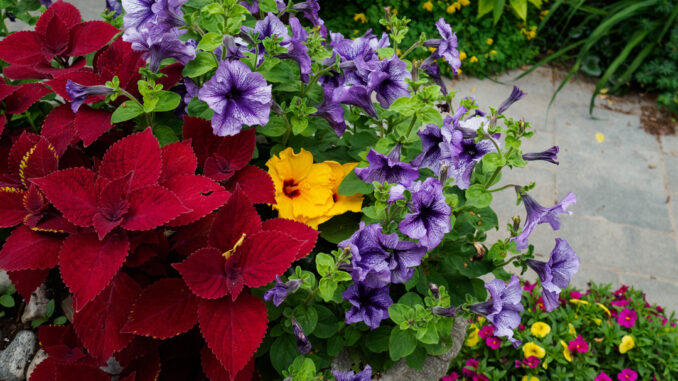
With summer upon us, our expectations are for another relaxed season at home and in the garden. But a warming climate and intense weather systems across Canada are demonstrating the need for quick strategies to get through weeks of intense heat. Timely intervention and simple changes in how we prepare for climate stress can sustain our favourite plants through current heat waves.
Intense heat can drain life from plants in a matter of hours. But quick intervention with simple and sustaining strategies will save the garden for better weeks ahead.
Hot enough for you?
Canadian forecasters of environment and climate change predict that 2026 will be among the hottest years on record.
Record-breaking heat is a frequent cause of crop loss, shrinkage of Arctic ice and snow reserves and uncontrollable wildfires. These are catastrophic regional events but, even on a smaller scale, intense summer weather can be destructive to a home garden.
Locations that are vulnerable to extreme weather settling in for weeks are difficult to predict, but it is likely that most regions will catch a period of scorching heat during July and August.
Plants require safe levels of exposure to heat and ultraviolet light to produce their flowers and fruits effectively.
But when heat waves generate excessively high temperatures, the delivery of UV light is greatly increased, resulting in the same effect as putting flame to soft plant tissues. The intense heat also enters the soil system, stressing plant roots in the ground.
Backyard vegetable patches and borders of ornamental summer annuals with no overhead tree shade are extremely vulnerable to intense ultraviolet exposure raising soil temperature and burning leaf tissues. Plants can possibly recover from two or three days of extreme UV exposure, but a week is too much and several weeks will extinguish potential recovery. Quick strategic action can make all the difference in moderating the stress on plants until heat subsides.
First, prevent heat from entering the root zone by mulching all exposed soil with a two- to three-inch layer of organic materials such as shredded tree bark or small bark nuggets, leaves, grass clippings and conifer needles. The mulch will blanket the soil, lowering the temperature in the root zone and preventing moisture evaporation. Cover soil at the base of shrubs and trees, as well as surrounding the stems of plants growing in containers.
Second, create shade wherever plants are growing in half- to full-day sun exposure. Plant foliage can be protected by using a white shade cloth or row cover fabric to shade the entire section. Shade-cloth fabric reflects 30% to 50% of UV rays away from plants, while allowing air and water to pass through. Low-growing vegetable and flower beds can easily be covered with low hoops supporting the shade cloth held in place by long soil staples. The very lightweight cloth can also be used for any grouping of ornamental plants or singular specimens needing protection, simply by draping it over the plant and using small rocks to hold it in place. Look for shade cloth (and hoops and soil staples) at garden centres or in garden catalogues. It comes in large sheets that can easily be cut with scissors to fit specific purposes.
Third, monitor soil moisture and provide water in increased and more frequent amounts. Using a simple probe-style moisture meter gives immediate notice when more water is necessary, and it can be used on both container and in-ground plants. At the height of a heat wave, some plants may require watering twice a day. When water restrictions limit the timing and amount of water use, drip-irrigation systems are the best way to give maximum amounts to plants. Drip-water systems are easily laid in containers and garden beds, delivering water directly above the root zone and avoiding evaporation from hose spraying.
And fourth, temporarily relocate container plants to shade locations such as close to the north side of a house, under a carport or inside an enclosed garage. This will keep them out of the worst dangers of extreme heat and burning sunlight until temperatures moderate.
Planting for future heat waves
With predictions of further heat wave summers ahead, it might be wise to plan on growing more container plants that are quick to water (sometimes twice daily) and easier to relocate to temporary shade when necessary. Add to that a moisture-retaining soil mix and familiar weather-resilient plants, and a container garden becomes a satisfying substitute for weather-endangered open beds.
Sturdy perennial plants such as hostas, ornamental grasses, sedums and repeat-blooming dwarf day lilies such as golden ‘Stella De Oro’, yellow ‘Happy Returns’, burgundy ‘Little Grapette’ and red ‘Little Business’ are adaptable to containers. Broad-leaved summer annual plants such as ‘Bulls Eye’ geraniums (with distinctive dark blotched leaves) can fill large containers by themselves and completely shade their own soil.
One useful strategy is the addition of vermiculite to the planting soil in containers. Vermiculite is sold at garden centres and through seed catalogues. It is a naturally occurring mineral used as a growing amendment, producing soft, porous soil with additional moisture-holding capability. Used as one-third of the soil mix in a container, it will enhance soil texture for root growth and provide a greater water-banking ability.
Vegetables such as potatoes, bush beans, dwarf cucumbers and dwarf tomatoes (growing to three-four feet in height) are all comfortable and productive in containers. Plan on searching seed catalogues early next spring for many kinds of vegetables that have been bred in dwarf heights for container growing.
By Judith Adam