
When leaving the house recently to pick up a rented garden tiller and some sheep manure to spread on my vegetable garden plot, my wife asked me why I still go to all that effort when we can get vegetables at our nearby grocery store. My answer was that it was for my own good health! After retirement, many of us turn to the easy life with not enough attention paid to keeping fit through daily physical activities. We subsequently suffer from diminished muscle strength, poorer balance, increased risk for falls and, in some cases, increased weight. Most of us have the opportunity to maintain a good level of physical health through participation in household activities, property maintenance, exercise programs, sports activities for seniors and certain hobbies. For snowbirds, the opportunities to keep fit are greater since warmer climates allow for such physical activities as walking, pickle ball, golf, tennis and swimming year-round.
Last week, we attended a dinner party and I asked the host ̶ a retired army major ̶ how he and his wife (who had moved from their large family home with a swimming pool) were enjoying his new abode, a small condominium in the heart of the downtown district. He had been an avid cyclist, had always done his own yard work, pool maintenance and household repairs and I suspected that he was now quite inactive. He said he recognized soon after moving that he was becoming weaker and far too inactive, so he recently joined a downtown gym which he attends most days of the week for physical activities.
Most adults over the age of 65 have one or more existing medical conditions and should engage in activities according to their individual health status. Sudden heavy exertion should be avoided and increasing any new type of exercise should be practised gradually. The sudden heart attack from heavy snow shovelling is commonly known, but regular appropriate exercises and physical activities result in better health at any age. Benefits include improved physical fitness and less loss of muscle mass, as well as improved stability and balance, thereby reducing the risk of injury from falls and helping with weight control. According to The Canadian Society for Exercise Physiology (csep.ca), those who follow their Canadian 24-Hour Movement Guidelines for Adults 65+ can, on average, see a 30% reduction in the risk of losing independence, premature death and morbidity, with greater physical activity levels resulting in a 60% reduction in risk.
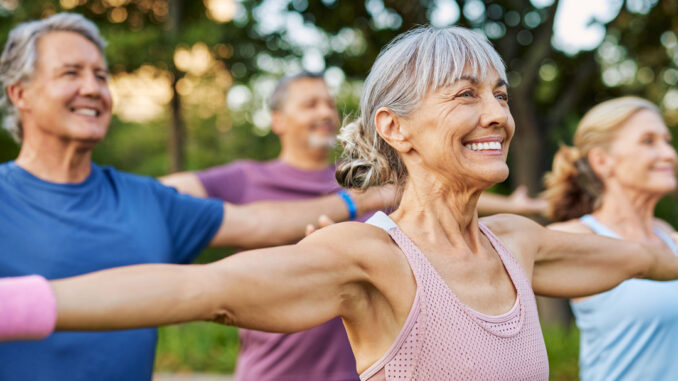
For those who prefer a more structured way of keeping fit, there are numerous organized programs available including tai chi, yoga, Pilates, chair tai chi, swimming and other structured class exercises. Such programs are available at a local YMCA, seniors’ centre or commercial gym and offer the benefit of professional coaching. Most gyms, seniors’ centres and Ys have trained staff on site who can initiate appropriate exercise programs ̶ in accordance with one’s health status ̶ that can be continued regularly on site or at home. Committing to a regular workout also provides social interaction.
While all physicians are well aware of the benefits of physical activities and exercise, very few seniors with whom I have spoken have ever been asked about this during physician visits. I never remember any such discussions myself. Over the last five years, I have three friends who moved to retirement homes. In each case, they had everything done for them and, although there were exercise rooms with lots of equipment in each home, these were only sparsely used. All three friends were using walkers within three months and two were needing wheelchairs at six months. The old expression “use it or lose it” applies.
Although I have exercise equipment including a treadmill, a stationary bicycle and exercise rubber bands, I rarely use them in the warmer months. I always prefer getting my exercise by walking our Husky, performing activities such as cutting the grass, tilling, seeding and weeding my own vegetable garden, as well as opening, using and closing my pool, along with regularly working on my hobby of antique auto restoration. Currently, I’m installing a new exhaust system on my 1928 Model A roadster. In the winter, if not either in the sunny south or at the curling rink, I dust off the stationary equipment, turn on the TV and do my regular daily workout. Some days, I do it even when I feel lazy and would prefer to just sit back and read or watch TV.
Keeping fit by participating in a variety of activities with less time sitting helps maintain muscle strength throughout your body. Reducing your sedentary time ̶ even by simply standing and walking ̶ improves your overall fitness. Try to keep your daytime nap to a maximum 45 minutes, your screen time to 3-4 hours maximum and sleep time to 7-8 hours.
There are at least five components to your physical activities including your muscular strength, endurance, cardiorespiratory fitness, flexibility and body composition. Improvements in these components leads to better balance, power, agility, speed, co-ordination and reaction time. This allows for improved ability to perform the activities of daily living, including household chores, certain sports activities, shopping and driving.
Keeping fit does not mean merely physical fitness, but mental fitness as well. Persons who have retired, those with an empty nest, those with a new or existing medical condition and especially those living alone are especially vulnerable to periods of depression, loneliness, anxiety or insomnia. Seniors who have had a busy life with work and family must now adapt to a different situation and should still maintain an active social life, develop new interests and social connections, participate in group activities, keep abreast of local and international news, re-establish interaction with relatives and start or rekindle a hobby. Many hobbies not only stimulate physical and mental aptitudes, they can also lead to interaction with others sharing the same interests. When not going south in the winter, regular curling keeps me in better physical condition, as well as facilitating regular social interaction with my friends.
Snowbirds have an opportunity to rejoin their winter friends with all of the social interaction and activities that are available, enhancing their physical and emotional health. Just as physical activity improves muscle strength, keeping active socially maintains and improves your acuity and mental health. Physical and emotional health are closely connected, and loneliness, isolation and depression are associated with increased risk of heart disease, stroke and diabetes.
Those who develop emotional and psychological issues and experience social withdrawal have little desire to maintain an active healthy physical plan, thereby accentuating their physical decline. Family members who identify these changes should assist in getting professional care for the individual. Family members who move to retirement facilities should be encouraged to actively participate in social, as well as physical activities to enhance body and mind.
Now, looking out my window, I realize it’s time to mow my lawn again… which I will do after my lunch and nap!