
Winter weeks are a good time to contemplate the changed growing conditions in Canadian gardens. Warm winters with longer frost-free periods and record-breaking summer heat with erratic rain can turn a garden upside down. It’s time to understand seasonal changes, and what we can do to help gardens adapt.
Record-breaking heat is here to stay in Canadian gardens, but it’s not all bad news.
A new kind of weather
The 2025 summer season presented unexpected challenges to every garden. Urban postage-stamp spaces, small vegetable patches, expansive suburban lawns and natural cottage landscapes – all were affected by intense heat, weeks of drought or flooding rain and changes in the growth patterns of familiar plants. Weather systems we once took for granted are now delivering dramatically different behaviour, and gardeners are challenged to understand how to adapt to these new influences.
A guideline map of changing weather conditions in every habitable Canadian location would be a useful aid to understanding the new climate systems – and we’ve got one. Natural Resources Canada acts as a perpetual weather monitor, analyzing detailed statistics regarding regional weather conditions over 30-year periods. The analysis is applied to a map of Canadian plant hardiness zones and indicates the seasonal expectations of low and high temperatures through all four seasons.
The last climate zone map was produced in 2014, and the most recent map became available in 2025 (based on data from 1991 to 2020). For the first time, there are significant changes in regional temperature predictions, with more than 80% of Canadian land locations showing an increase in up to two full temperature zones. In simplest terms, this means more moderate temperature in deep winter with less penetrating frost in soil, bracketed by extended autumn and spring periods and considerably warmer summers with frequent droughts. This is important news for growers of every kind, from a window box full of petunias to a field of canola.
The plant hardiness zone map is based on only six criteria applied to specific locations: lowest average daily temperature in the region’s coldest month; days of frost-free periods above zero centigrade (0 C.); amount of rainfall from June to November; highest average daily temperature during the zone’s hottest month; severity of winter; and maximum snow depth and wind gust over 30 years. Locations on the map are divided into nine regions, from warmest (zone 9) to coldest (zone 1); and each region is divided into an A section indicating colder and B section indicating warmer.
As examples of the statistical changes, the new climate map indicates that Timmins, Ont. has risen by half a zone rating from 2a to 2b, a moderate rise allowing for a selection of new plants that will survive in the warmer winter. But Winnipeg, Man. has risen by a full zone rating from 2b to 3b, and that is a significant increase of warmth that will affect both garden plants and the harvesting dates for agricultural crops. These climate changes are not predictions; they are already upon us.
To find the current hardiness zone statistics for your garden, an internet search for ‘Canada’s Plant Hardiness Site’ will take you to all the information for your specific location.
Getting a grip on growing in the new weather
These changes to the four seasons will amount to an upheaval in growing conditions. Plants such as roses and tomatoes that once thrived in full sun locations may now perform better in part shade, with protection during midday when the sun is at its highest arc. Vegetable patches with full sun exposure may also need protection, by using shading row covers. Using simple lightweight stakes to help support a spun fabric row covering over struggling plants will help to cut down on ultraviolet rays reaching foliage. The covering can remain for the hottest periods of summer and then be easily removed when temperatures become more moderate.
Woody plants such as maple, spruce and lilac that have survived for decades with rain moisture alone will benefit from supplemental watering to prevent premature leaf drop and wood die-back. Tomatoes will drop their flowers when exposed to prolonged intense heat. You’ll know that perennial and annual plants need help when they show signs of wilt despite adequate watering, or if foliage has dry crispy edges. Broad leaf plants such as hostas may develop scorched areas on the broadest leaf sections.
Along with protection from intense heat exposure, providing generous soil moisture is essential. Midday sun exposure can overwhelm plant foliage that is unable able to pump water up fast enough to prevent wilting; but if soil moisture is available, they will return to turgid posture once the sun passes off leaf surfaces. It’s important to have sufficient moisture in the soil to adequately meet their daily needs. A two-inch mulch of leaf litter over exposed soil is a good way to keep soil moisture from evaporating.
On the upside, some tender trees such as redbud, magnolias and Japanese maples may now be grown in regions beyond their historical northern limits. Certain annual plants such as dahlias, pansies and canna lilies could also be used as perennials and left in the ground over the winter. It may also be possible to grow some of the more frost-resistant cultivars of figs outdoors without lifting and burying the trees in winter. Enhanced growing advantages such as these will depend on the temperature rise in each region. It will be a new opportunity to experiment and see how far each growing location has changed.
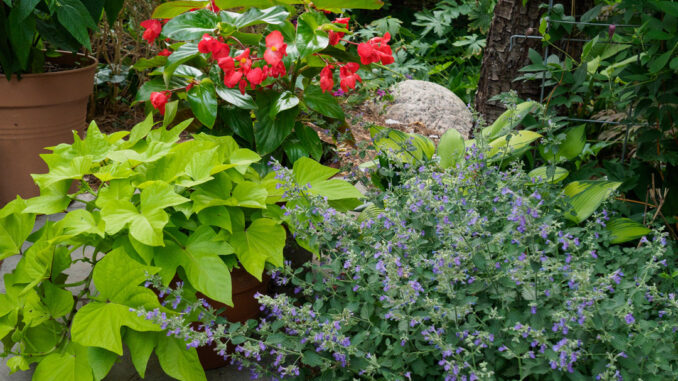
An effective strategy would be to invest in reliably heat-tolerant perennial plants that can withstand the intense heat of summer. Among them, look for catmint (nepeta), sedums, creeping thyme, sprawling potato vine, dwarf golden daylily ‘Stella D’Oro’, lavender, coneflowers (echinacea), yarrow and salvia.
By Judith Adam