
If departure for winter warmth is approaching, there may be some last projects and a shortcut or two that, quickly accomplished, will make a pretty picture for your return in the spring. The time is right for planting spring-blooming bulbs, and wouldn’t it be nice to have them as early as possible? Well, when you know something about stem heights, you can.
Last-minute tidying brings spring reward.
This year’s summer heat may have driven you indoors, and there were days on which that was the best place to be. Usual maintenance tasks might have been abandoned, and water restrictions may have left the soil parched and hardened. However, there’s still an opportunity to get some basic work done that will be appreciated in the spring.
The most important task is gathering leaves (both large and small) and conifer needles and using them for a two- to four-inch-thick mulch over all exposed soil in beds and around shrubs and trees. Leaves contain important nutrients such as phosphorus, potassium, magnesium and iron that are released when composted and returned to the soil for plant roots to absorb. Over the winter, leaves will sink down and begin to compost in place where they are laid. Don’t hesitate to use the conifer needles; it’s a misconception that these are excessively acidic. If you don’t have enough leaves, your neighbours may be happy for you to rake their surplus.
The cooling temperatures of autumn are an opportunity to address simple tasks that make an encouraging difference in the spring. If garden beds are disorganized and there isn’t time for a basic cleanup before winter, removing tall and long stems is enough to discourage closer examination. It’s an old gardener’s trick to use a blunt-nosed spade to cut a fresh edge to the beds, drawing attention to the clean line and distracting from the possible chaos behind.
Long vines (such as honeysuckle) and plants with tall canes (such as old-fashioned and climbing roses) need support to keep them vertical in strong wind and heavy snow. Anchor them with bamboo poles and secure with ties. Hardy shrubs in your garden probably don’t need the special protection of burlap wrapping. If a shrub is vulnerable to regional winter weather it can be wrapped, being careful not to compress the branches. Wrapping will not protect from cold temperatures, but it will help to prevent wind burn on broadleaf evergreens such rhododendrons. Cold-sensitive plants such as lace leaf Japanese maples and figs are better grown in large containers and moved into garage storage for winter. Patio and doorstep containers should be emptied of soil and turned over. Terracotta pots are particularly vulnerable to cracking when frozen soil expands in them over winter.
Attention to these basic small projects in autumn will leave the garden partially groomed and ready for detail work in the spring, without feeling overwhelmed by seasonal tasks.
Plant bulbs in autumn for spring reward.
Autumn is the season to purchase and plant spring-flowering bulbs that will bring joy at the end of the winter. Starting in March, gardeners haunt the windows in search of any outdoor green tips that might be poking above ground. The surveillance intensifies daily until finally, a small, close-to-the-ground flower is found and celebrated. But that only happens if spring bulbs have been planted in autumn.
If the earliest possible appearance is considered most important, then it makes sense to purchase bulbs that are identified as ‘early blooming’. Most often, bulbs are sold with an indication of which part of the spring they will be in bloom (early, middle, late). Another way to identify bloom sequence is to check the height of flower stems. Early-blooming bulbs will have the shortest stems. Tulips in the single early group, such as small botanical tulips, larger Fosteriana, Kaufmanniana and Greigi might have stem lengths of four to 12 inches. Mid-season tulips such as Triumph and Darwin hybrids will have stem lengths of about 14 to 22 inches. Late tulips such as fringed, parrot and lily-flowered are likely to be 20 to 28 inches tall. Similar blooming seasons and heights are also categorized for narcissus. Garden centres and mail-order nursery catalogues will indicate the season of bulb bloom, but may not always list the flower and stem height. You can make a quick internet search for a flowering bulb’s actual expected height.
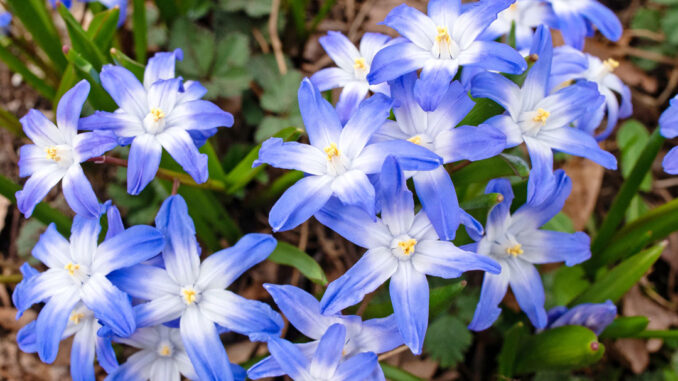
For earliest bloom, look for flowering bulbs with shorter heights. Almost everyone will recognize the early appearance of short-stemmed crocus, which may bloom close to ground level even as the snow is melting. Some of the shorter tulips growing to less than 10 inches have quite substantial bloom size and make a colourful impact in still-frigid temperatures. Other early bloomers include the minor bulbs such as dark-blue wood squill (Scilla siberica), the dainty white-and-pale-blue striped squill (P. libanotica), and the bright blue-and-white glory-of-the-snow (Chionodoxa).
Blooming schedules for spring bulbs change with climate conditions across the continent. Consequently, pinpoint scheduling for spring bloom designations isn’t entirely accurate, but it’s likely close enough to deliver early delight wherever you garden.
Another consideration is how many years of return can be expected from spring-blooming bulbs. Bulbs for market sale have been grown with generous amounts of fertilizer, allowing them to produce large blooms in their first season in your garden. Some returns can be expected for the second and third years, perhaps with fewer stems blooming and smaller flowers; but after that, it’s time to replace them with new bulbs.
The genetic characteristics of some early-flowering bulbs allow them to manufacture enough energy to carry on for several years. A short list of long-performing spring bulbs to look for includes tricolour crocus, wood squill, striped squill, narcissus ‘February Gold’, ornamental allium ‘Purple Sensation’ (mid-spring blooming) and any of the Darwin hybrid tulips (late blooming). These all bring many years of spring flowers.
By Judith Adam