
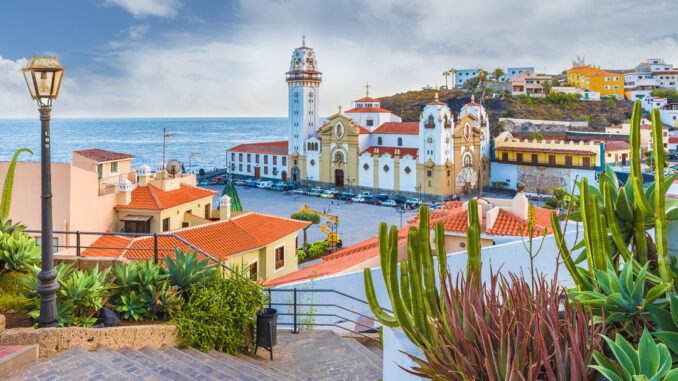
A chain of sunny Spanish isles filled with surprises.
Sometimes called “the Hawaii of Europe,” the Canaries are remarkably similar to the famous Hawaiian Islands. Both possess beautiful beaches, a subtropical environment, lush rain forests, historical sites and a unique cultural identity. Of course, the major difference between the two is location. They lie on opposite sides of the globe, with Hawaii situated in the central Pacific Ocean and the Canary Islands lying in the Atlantic off the northwest coast of Africa. Both are volcanic archipelagos with year-round sunshine and long histories as popular travel destinations, although it took the Spanish Canaries longer to develop their global reputation. The British and Europeans discovered them decades before the chain’s many endowments – natural and otherwise – became known to people worldwide. Today, the islands welcome millions of visitors a year, knowing that they can count on reliable weather and an abundance of interesting things to see and do.
Like the Hawaiian Islands, the Canaries were formed by volcanic eruptions millions of years ago, hence their geographic similarities: a mix of mountain peaks, volcanic cones, fertile valleys and verdant forests. The islands also boast great stretches of beautiful sand beaches, together with dramatic cliffs and rocky coastlines. As a group, there are eight main islands and several islets that, collectively, are an autonomous region within the nation of Spain. Prior to Spain’s conquest of the islands in the 15th century, a rich history had already been shaped. The seeds of it were originally laid by an indigenous north African population that first settled the archipelago around the first millennium BC. They were later followed by the arrival of European explorers and traders from France, Portugal and beyond. The multiple mix of different cultural backgrounds continued to flourish over the centuries, producing the Canaries’ unique identity and character, qualities that helped stoke the islands’ reputation as a big-league player among world travel destinations. The melting pot that exists there today is revealed through various cultural traditions: cuisine, arts, festivals, music, museums and more. Overall, there is much about this beautiful chain of islands that makes it an attractive winter escape for many. In fact, recent statistics show a rising number of Canadian snowbirds opting for long-term stays there – especially during February and March. While each of the eight primary islands shares the commonality of abundant beaches, stunning volcanic landscapes and lush forests, each singularly possesses its own distinctive personality and attractions. Excellent flight and ferry links make island-hopping easy for both visitors and long-stay snowbirds, who can settle on one island with easy access to all others. Island by island, here is a glimpse of what this beautiful, “winter sun” destination has to offer.
Tenerife
The archipelago’s largest and most visited island boasts a bonanza of beaches, with dozens of them featuring either golden sand or the black volcanic variety. Widely known as the “island of eternal spring,” Tenerife is saturated with an impressive array of attractions from natural wonders to exciting theme parks, scuba diving, whale-watching, kayaking, paragliding and catamaran tours. The island is also dotted with flea and street markets selling everything from local handcrafted items reflecting the Canarian culture, to antiques, clothing, local cheeses, fresh produce and more. Cash is king at these markets and bargaining is expected. There are also numerous historical and cultural venues, plus a reputation for some of the finest wines in Europe, together with multiple Michelin-star restaurants. On the flip side of fine dining, Tenerife boasts a plethora of regular eateries serving genuine Canarian food at reasonable prices.
While the island brims with things to see and do, there are certain must-see highlights. Topping the list is Mount Teide – the third-highest volcano in the world and the highest peak in Spain. Dominating a lunar-like landscape, the mountain is the star of the island, together with Tenerife’s Mount Teide National Park, a UNESCO-listed site of remarkable beauty. There are numerous hiking trails for all levels, in addition to cable cars for transporting visitors to the upper viewing station of this currently dormant volcano. Beyond Mount Teide, the island is full of surprises such as an Asian-themed water park featuring the world’s largest artificial wave pool. Considered among the best water parks on the planet, it features extreme, free-fall slides and a host of other adrenaline-pumping thrills. Tenerife’s tableau of activities also includes underwater submarine tours, a monkey park, botanical gardens and tandem paragliding. Island excitement peaks in February, with the Santa Cruz de Tenerife Carnival ranking second only to Brazil’s world-famous Carnival of Rio de Janeiro. The buzzing, festival city of Santa Cruz lies cheek by jowl with the neighbouring community of La Laguna, widely considered Tenerife’s most beautiful city. Designated as a UNESCO World Heritage Site, Laguna is famous for its colonial architecture and historical significance.
Gran Canaria
The Canaries’ third-largest island boasts an abundance of enticing activities and beaches galore. There are more than 80 of them, from the iconic, dune-backed beaches on the south coast to others scattered along the island’s perimeter. The island’s capital – Las Palmas – features a vibrant arts scene, numerous historical sights such as the oldest defence fortress in the Canaries, plus a palace that once hosted Christopher Columbus. Today, this historic edifice (Casa de Colon) is a museum dedicated to the explorer’s four voyages to the Americas, as well as to the history of the Canary Islands.
Among several island highlights is the picturesque town of Puerto de Mogen, nicknamed the “Little Venice” of Gran Canaria for its charming canals and whitewashed buildings. The whole island is jam-packed with activities and attractions that include crystal-clear waters for snorkelling, together with fishing, whale-watching, endless hiking opportunities and camel riding. In fact, popular camel-riding tours exist across the Canaries, a tourism scheme that sprang up when modern techniques replaced the archipelago’s tradition of using camels as pack animals. Overall, Gran Canaria is an island that provides something of interest for everybody, including a host of bustling resorts and vibrant nightlife, together with endless eateries from rural taverns to casual waterfront restaurants and fine dining options.
Fuerteventura
The second-largest island in the chain, Fuerteventura, is generally considered the Canary Island which has the best beaches. Its miles of white and golden sand – and its strong winds – make it a top destination for surfing, windsurfing, paddleboarding and kitesurfing. However, the island has much to offer beyond its spectacular beaches. Among its popular activities are dune buggy safaris, glass-bottom boat tours, volcano hikes, vineyard tours and excursions to the island’s famous Ajuy Caves. Beyond the island capital of Puerto del Rosario, there is a host of charming towns flavoured with colonial architecture, cobblestone streets, whitewashed buildings and limitless dining options featuring everything from traditional Canarian dishes to international cuisine. Shopping across the island includes everything from modern malls to street markets.
Lanzarote
Known for its breathtaking volcanic landscapes, national parks and good beaches, Lanzarote is the Canaries’ fourth-largest island. One of its jewels is the Timanfaya National Park covering nearly 20 square miles of dramatic landscape. This Mars-like park is a must-see visitor attraction consisting of still-active volcanoes, lava fields and sand dunes. More than 1.5 million people a year visit the park to see, among other things, demonstrations of continued volcanic activity. A 14-km trail weaves its way among the park’s different craters; one park restaurant uses geothermal heat from the volcano to cook its typical Lanzarote dishes. Another of the island’s big attractions is the Jameos del Agua natural cave complex featuring an underground lake and concert hall. Like its larger sister islands, Lanzarote features the same general attractions as the others: excellent beaches, water sports, whale-watching, traditional Canarian dining, interesting small towns and the archipelago’s distinctive street markets. On Lanzarote and across the islands, traditional Canarian dining is a distinctive culinary landscape marked by a mix of indigenous flavours and techniques brought by the Spanish colonizers. Visitors can expect reasonably priced meals, often featuring hearty stews, grilled meats and fish, and fresh-from-the-farm, locally produced fruits, vegetables and cheeses.
La Palma
Ranking fifth largest of the Canaries, La Palma is the most northwesterly island in the archipelago – bearing the nickname “Isla Bonita,” or “Beautiful Island.” While it has its share of remarkable volcanic landscapes, unlike some of the other islands in the chain La Palma is particularly green and forested – hence its second nickname, “The Green Island.” Among its several highlights is the Calderone de Taburiente National Park known for its pine forests, dramatic waterfalls and enormous, crater-shaped formation. Overall, the park offers awe-inspiring landscapes with a variety of hiking trails – from challenging to modest – all set within the massive crater that dominates the northern part of the island.
A trip to La Palma would not be complete without visiting the island capital of Santa Cruz. This colourful relaxed city is dotted with 15th-century buildings reflecting the colonial era, as well as cobblestone streets, quaint cafés, relaxed eateries and the archipelago’s ever-present street markets. A former convent houses the island’s museum containing an impressive fine art collection and natural history exhibits. In addition, the Naval Museum features a replica of Christopher Columbus’s 15th-century Santa Maria sailing ship. Beyond the capital and across the island, star gazing isn’t likely the first tourist attraction that comes to mind, yet La Palma is famous for it. The island has been certified as a Starlight Reserve, an accreditation deeming it to be one of the best places in the world to observe the heavens. Scientists from around the globe come to the island to study the solar system and beyond, thanks to the powerful telescopes at the Roque de los Muchachos Astrophysical Observatory. There are guided, daytime tours of the observatory (where there are 13 gigantic telescopes, including the largest in the world) but, when night falls over La Palma, star gazing is a simple matter of looking up and enjoying the display.
La Gomara, El Hierro, La Graciosa
Among the archipelago’s eight main islands, these three Canarian siblings are the family’s smaller ones. Their small size does not, however, diminish their various attributes or attractions, including what they have in common with the archipelago’s bigger members – stunning landscapes, beautiful beaches, charming villages, whale-watching and more. Like the bigger islands, the smaller three have developed their own personalities. La Gomara is known for its ancient, subtropical laurel forests and the unique whistled language (Silbo Gomero) historically used by islanders to communicate across deep ravines and valleys. This language is alive and well and island visitors often witness demonstrations of it in various public settings. El Hierro, the smallest of the Canaries, is renowned for excellent scuba diving and snorkelling in its crystal-clear waters. Hiking through a diverse volcanic terrain and shady forests, as well as cycling, paragliding and more, help illustrate that the island is a true microcosm of its bigger relatives. The same can be said for La Graciosa, even though it’s the only uninhabited island among the chain’s main group. With an abundance of attractions much like those found on its larger siblings, its reputation for some of the finest golden sand beaches in the archipelago give it legitimacy within the Canary Islands family. Overall, the exceptional commonalities that exist throughout the chain, from the largest to the smallest, tend to level the playing field across all eight Canaries.
Canary Islands Travel Planner
A valid Canadian passport good for three months beyond the planned departure date from Spain is required.
A visa is not required for Canadian citizens for tourist stays up to 90 days in length.
Customs officials may ask to see a return or onward flight ticket and proof of sufficient funds to cover the stay.
The currency of Spain is the euro (EUR).
The official language in Spain and the Canary Islands is Spanish, although English is widely spoken.
For more Canary Islands travel information, visit the official online website at www.spain.info/en/region/canary-islands/